





Privacy Trees
29 products
We’ve been growing landscape plants since 1980. We know it’s almost impossible to achieve a 100% survival rate. That’s why we’ve got you covered!
Our Perfect Plants 1 Year Warranty is roughly 10% of your plant total. It’s a cost-effective way to guarantee your plants for a full year.
If a plant dies up to 1 year after purchase, whether it's a weather related issue, human error, or anything else, just send us a picture at customerservice@myperfectplants.com and we’ll get you a store credit for the plant you purchased. The warranty does not cover the cost of shipping for any replacement.
Warranty must be purchased at the time of checkout and cannot be added after your order has been completed.
It’s that simple! Enjoy your new plants in confidence. Guarantee your plants for a full year today!
29 products
Privacy trees are one of the most practical and rewarding investments you can make in your landscape. Whether you need a living fence along the property line, a screen to block a neighbor's view into your backyard, or a windbreak along an exposed side yard, the right tree makes all the difference. We grow and ship a hand-selected range of fast growing privacy trees directly from our North Florida nursery, so what arrives at your door has been cared for from day one. Some of our fastest options, like the Thuja Green Giant, can put on 3 to 5 feet of new growth per year. Beyond the obvious screen effect, these trees clean the air, absorb noise, and help buffer strong winds.
For the fastest full screen, choose Thuja Green Giant. For narrow spaces, Emerald Green Arborvitae is a better fit. For large property lines, Leyland Cypress creates dense evergreen coverage quickly. If seasonal color matters, mix in deciduous privacy trees for a more natural landscape look.
The first decision when choosing a privacy screen tree is whether you want year-round coverage or seasonal color. Evergreen privacy trees hold their foliage all twelve months, giving you a dense, consistent screen no matter the season. They tend to live longer and fill in faster as a living fence along a fence line or property border. Deciduous trees drop their leaves each fall but often reward you with spectacular color, flowering displays, or interesting branching structure through the winter months. Check out our Evergreen Privacy Tree Grow Guide to dig deeper into what makes these workhorses so reliable.
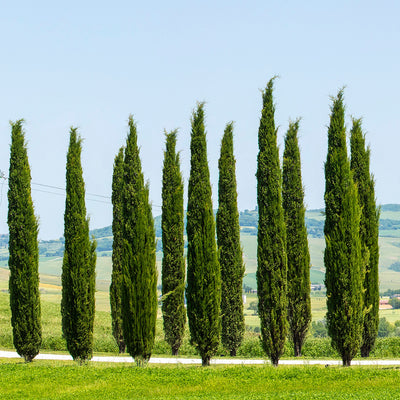
Both types come in a wide range of mature heights, canopy widths, and growth habits. Tall, columnar varieties are ideal where space is tight, acting as a narrow tree fence that takes up minimal square footage. Broader, bushier types work well when you want a fuller visual buffer or a layered hedgerow effect. Read our Top 5 Trees for Privacy guide to compare your best options side by side, and browse our privacy hedges guide if you want to pair trees with lower shrubs for a layered screen.
If speed is the priority, a few standout varieties consistently top the list of fastest growing trees for privacy. The Thuja Green Giant is a crowd favorite, gaining 3 to 5 feet annually and reaching mature heights of 30 to 40 feet with a naturally pyramidal shape that rarely needs shaping. Leyland Cypress is another quick grower that forms a dense, feathery screen along fence lines in just a few seasons. Cryptomeria Radicans offers a slightly softer texture and exceptional cold hardiness for those in the upper South. The Emerald Green Arborvitae is one of the best small privacy trees for tighter spaces, staying narrow and tidy without heavy pruning. All of these are among the most popular choices for homeowners looking for affordable, fast growing privacy trees that still look polished and intentional in the landscape.
For front yard plantings where curb appeal matters as much as screening, consider pairing a tall columnar evergreen with a flowering accent tree for color and interest. Many of our customers use a mix of fast growing privacy plants along the back fence and smaller ornamental trees along the front property line for a layered, professional look.
Most privacy trees are low maintenance once established, but the first year or two after planting sets the foundation for long-term success. Before you dig, evaluate your planting site. Does it have well-draining soil, or does water tend to pool after rain? Most shade and privacy trees perform best in consistently moist, well-draining soil. Sandy or loamy soils are generally fine as long as moisture is maintained through that first establishment period. Note how much sun your site receives daily, as most of these trees prefer full sun though several tolerate partial shade.
Dig a hole roughly twice the width of the root ball and no deeper than its height. Set the tree so the root flare sits at or just above grade, backfill with the native soil, and water thoroughly. For the first four weeks, water your newly planted tree daily to help it settle in and develop a strong root system. See our Maple Privacy Tree Grow Guide for detailed planting steps on one of our more colorful screening options.
Spring and early fall are the ideal windows for planting privacy trees. Mild temperatures and more consistent rainfall give new root systems time to get established before the stress of summer heat or winter cold arrives. If you are planting a full privacy screen or tree fence along a property line, spacing matters as much as timing. Check each variety's mature spread so the trees grow together naturally without crowding. Read our guide on planting a privacy fence or screen for spacing recommendations by species.
Before purchasing, verify your USDA hardiness zone using the tool at the top left of our website. Privacy trees work in backyards, along side yards, at property boundaries, and in front yard landscapes. Think about what you are screening for: a neighbor's second-story window calls for a tall, fast grower, while street noise might be better addressed with a dense, multi-layer planting of trees and shrubs together. The location will narrow your choices quickly and save you from buying something that outgrows its space.
Late winter or early spring, just as the dormant season wraps up, is the best time to prune privacy trees. Avoid pruning during peak insect activity, as fresh cuts can attract pests and create unnecessary stress on the tree. When you do prune, start by removing any dead, diseased, or structurally weak branches before shaping. Never remove more than about a third of the canopy at once, especially on younger trees, since the foliage drives food production and removing too much too soon can set growth back significantly. Once problem wood is cleared, shape lightly to maintain the density and height you want from your privacy screen.
Beyond pruning, most fast growing screening trees benefit from an annual application of a balanced fertilizer in early spring and a fresh layer of mulch around the base to retain moisture and regulate soil temperature. These simple steps keep your trees healthy, vigorous, and doing their job year after year.
Not every yard calls for a 40-foot wall of green. If you are working with a smaller lot or a townhome backyard, small privacy trees like the Emerald Green Arborvitae or columnar varieties give you meaningful screening without overwhelming the space. For larger properties, tall privacy trees like the Thuja Green Giant or Leyland Cypress create a dramatic, full-coverage backdrop that also adds significant value to the property. Many of our customers also mix evergreen trees with deciduous options for a hedgerow that provides color through spring and summer and solid structure through the winter months.
Whether you are building a living fence for a neighbor, a screen for your backyard patio, or a windbreak along a rural property line, we carry options that fit the scale and style of your project. Have questions about which variety fits your zone, soil, or spacing needs? Browse the collection above or reach out to our team directly.